"Despite the broad literature on the history of collecting, the material used as basis for those studies remains scattered all over the world and usually hidden from sight. Specimens that exemplify the collecting process, although often recognized for their historical importance, are kept out of context, in scientific, historical or art collections [...] Examples taken from The Tricottet Collection show how the collection-object, with its biography and collection attributes, is the 'guarantor' of the history of collecting."
Arnaud Mignan, Metacollecting or the process of collecting collections, with examples from The Tricottet Collection, 2018:1
Collector's note: The TC was founded in 2006 in honour of my grandfather, Guy Tricottet (1926-1993), the most influential figure of my childhood. To me, he embodied stability and wisdom, qualities I deeply cherished. Although he was not a collector himself, his name came to be attached to a collection devoted to the history of collecting. It was only in 2024, following the passing of my father, Patrick Mignan (1955-2024), and subsequent conversations with my uncle, Eric Mignan, that I finally came to realise that collecting had long been a hallmark of the Mignan side of the family.
A Collection of Collections
The TC is, in essence, a collection of collections, or a meta-collection. It brings together pedigreed objects from notable private collections, rare collectibles, and materials relating to the history of collecting (Collectiana): collection catalogues and notices, portraits of collectors and their cabinets, as well as ephemera such as correspondence and related documents. Its purpose is to assemble and curate a representative body of material that illustrates the history of collecting.
Unlike other initiatives, the TC is the only project to consider the full spectrum of collecting across a span of five centuries. It traces the evolving history of private collecting (so far, in Western civilisation) from the Renaissance to the modern era. This narrative unfolds across the eight galleries of the TC website, which together constitute the TC's online catalogue. Each gallery focuses on a distinct collecting domain, in alphabetical order: art, books, geological specimens, historical artefacts, instruments, natural history specimens, pop-culture objects, and Wunderkammern. The material presented functions, in part, as a catalogue raisonné, providing detailed descriptions, provenance research, and interpretive context for every item included. At the same time, it operates as an exhibition catalogue, presenting a curated selection of objects chosen for their exceptional pedigree, rarity, or illustrative power, and using them to illuminate the evolution of collecting practices.
Within these pages, the collector emerges as a discerning connoisseur, pursuing rare and meaningful objects through discovery, purchase, and exchange. Scholars appear where their work contributes to our understanding of the history of collecting. Institutions, too, play a vital role, whether as occasional sources of deaccessioned material or as the ultimate repositories of important private collections. Rare collectibles are included even when lacking an illustrious pedigree, provided they transcend their physical nature to become, within their respective fields, a collector's holy grail.
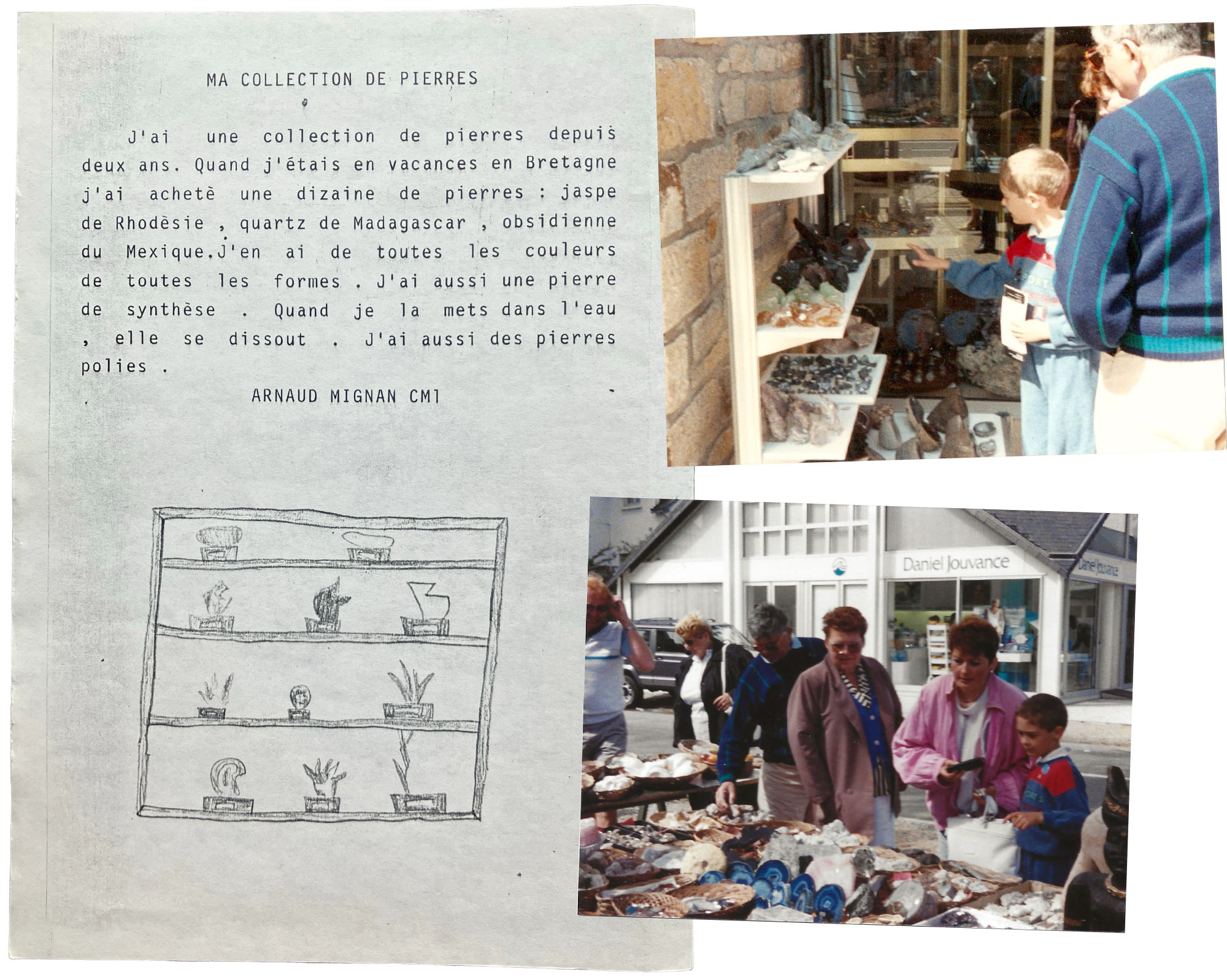
Collector's note: I began collecting at a very early age in my home village of Rollot, in the Somme department of France. The earliest surviving description of my childhood collection appears in a school booklet from 1989. It reads: "MA COLLECTION DE PIERRES. J'ai une collection de pierres depuis deux ans. Quand j'étais en vacances en Bretagne j'ai acheté une dizaine de pierres: jaspe de Rhodésie, quartz de Madagascar, obsidienne du Mexique. J'en ai de toutes les couleurs de toutes les formes. J'ai aussi une pierre de synthèse. Quand je la mets dans l'eau, elle se dissout. J'ai aussi des pierres polies." The 1987 trip to Brittany mentioned in the text was a defining moment, documented in two photographs featuring a young Arnaud alongside his family, including Guy Tricottet, browsing mineral dealers' stands. That early collection was eventually given to some cousins in the late 1990s, and its present whereabouts remain unknown, if, indeed, it has survived at all. While minerals and fossils formed the core of my childhood collecting interests, I assembled several smaller and more ephemeral collections as well, including coins, pins, phone cards, and baseball cards.
Collector's note: In 1998, I moved to Paris to study geology, where I found myself among like-minded students who shared my enthusiasm for hunting fossils and minerals. The collection I had begun in childhood expanded through field finds and further purchases. By 2001, however, the collecting impulse had begun to fade as my interest in geology shifted from fieldwork toward computer modelling. I was also preparing for my first trip to the United States, where I would spend six months at UCLA as part of a student exchange project. That year, I sold nearly all the minerals and fossils I had acquired over the years to help fund the trip. Although regrettable, the sale is at least documented in an advertisement published in a 2001 issue of Minéraux & Fossiles: "Vends collection complète de minéraux, fossiles et météorites. Parmi les minéraux: azurite et cuprite de Chessy-les-Mines, pyromorphite des Farges, fluorine de Peyrebrune et du Burg, pyrite d'Huanzala...". A measure of connoisseurship was already present, with specimens from historically significant French localities. Few of the purchases made between the 1990s and 2000 remain in the collection, while most of the specimens found in the field have survived [More on these specimens later].
Rationale: The Collection Object
The mission of the TC is to address a gap in museology by creating a collection cabinet in which the collection-object transcends the intrinsic nature of the original object and acquires an extrinsic socio-historical value (Mignan, 2016; 2018). Within this framework, a mineral specimen, a signed baseball, a complete-in-box video game, or an antique coin become equivalent insofar as they are interpreted primarily through their chain of custody, their labels, and their appearances in catalogues and other documentary traces. The intrinsic nature of the object remains relevant only insofar as it bears directly on its collectability: its rarity, aesthetic appeal, or historical resonance.
Provenance Principles
Within the TC, provenance is not a supplementary detail but the primary axis along which each object is interpreted. In traditional museology, provenance serves chiefly to authenticate an artefact and situate it within a cultural or chronological context. In the TC, by contrast, provenance is the object's central meaning-bearing structure: it reveals the intentions, tastes, and networks of the collectors who shaped its biography, and who, through their actions, transformed the object into a collection-object.
The TC therefore adopts a set of provenance principles that extend beyond standard descriptive cataloguing:
- Provenance ranking. At the core of the TC is the principle that previous owners must be significant figures in the history of collecting. Their collections may have been celebrated through publication, public display, or landmark auctions; their collecting practices may have been innovative, trend-setting, or reflective of broader cultural movements; or their scholarship, institutional contributions, or personal networks may have shaped the evolution of a collecting field. Objects are thus selected not only for their inherent qualities as collectibles but for the cultural, intellectual, or historical resonance of the collectors through whom they passed.
- Material evidence. Labels, inventory numbers, signatures, coats of arms, annotations, mounts, frames, wrappers, boxes, and accompanying ephemera are preserved as integral components of the object. These traces often provide the earliest and most reliable clues to pedigree and form a direct physical link to the object's past lives. In many cases, the material evidence constitutes the only surviving testimony of a historical collection, making its preservation essential.
- Documentation. Each item is accompanied by a dossier compiling all known references to it in collection catalogues, sale and auction catalogues, institutional inventories, correspondence, scholarly articles, or illustrated sources. These documents are not treated as secondary literature but as extensions of the object itself, situating it within a broader socio-historical framework. This continuous recovery of documentation (sometimes fragmentary, sometimes unexpectedly rich) is central to the TC's mission to reconstruct each collection-object's full biography.
- Chains-of-custody. In meta-collecting, a multi-owner chain provides a second level of interpretive richness, revealing networks of collectors and potentially long, intricate object biographies. Whenever possible, dates of accession and deaccession are recorded, and intermediary collectors (especially those who preserved earlier provenance) are acknowledged for their essential role in safeguarding the object's story. The TC does not attempt to fill gaps in provenance without evidence; breaks in the chain of custody are noted explicitly, as transparency preserves the integrity of the historical record. Each pedigree thus becomes a chapter in a wider narrative of taste, fashion, scholarship, and cultural value.
Through these principles, the TC establishes a rigorous and coherent method for transforming ordinary objects into collection-objects, each embedded in a rich, verifiable, and culturally meaningful history of ownership.
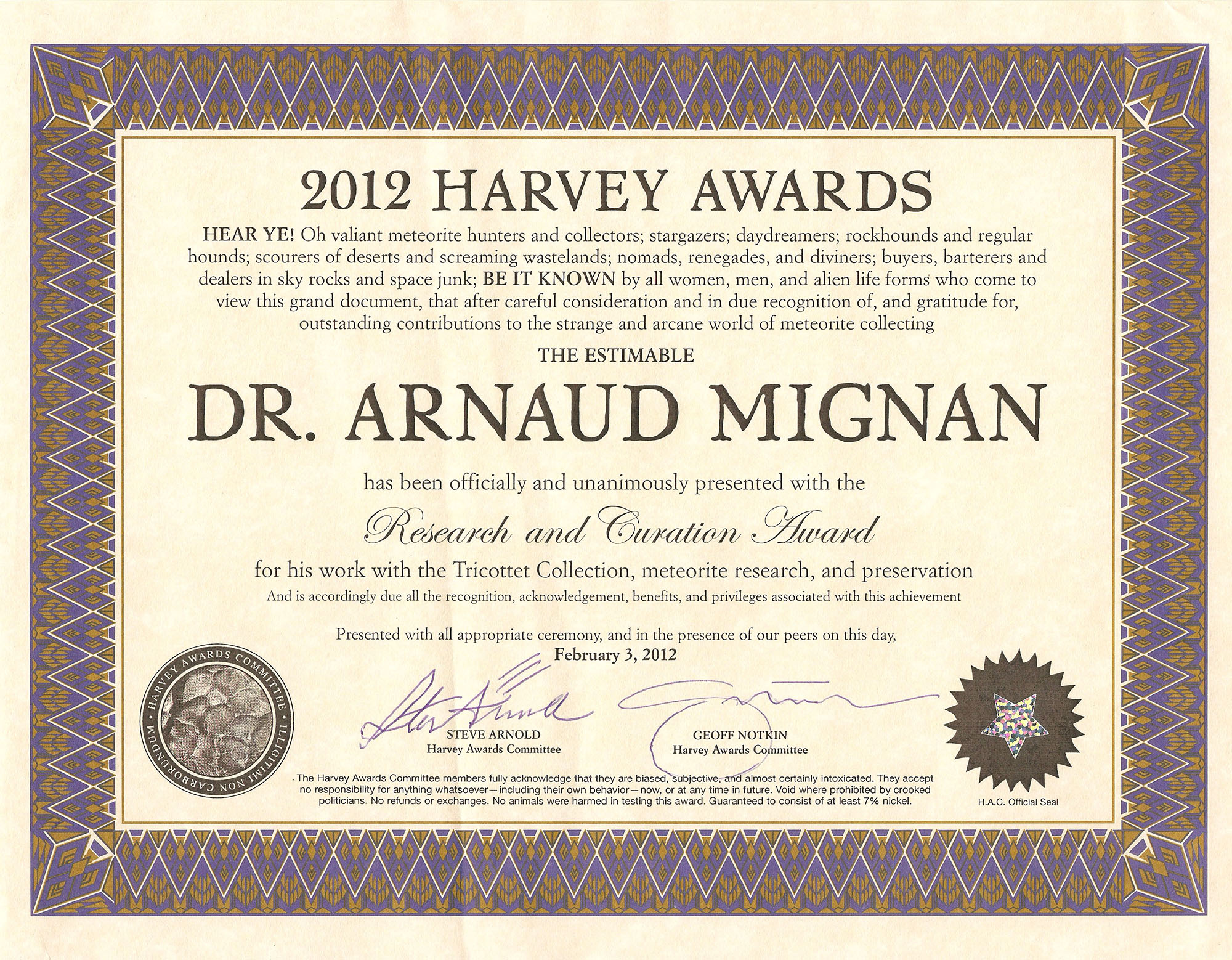
Collector's note: It was toward the end of my PhD in Paris that I began assembling a second collection, after joining eBay on 29 December 2005. This opened my eyes to the broader world of collecting, and I was quickly hooked, initially seeking aesthetically remarkable meteorites, minerals, and fossils. It was through eBay that I discovered the importance of provenance in meteorite collecting and began acquiring pedigreed meteorites [read more]. The collection truly flourished from 2010 onward, once I was based in Switzerland. January 2010 marked the launch of thetricottetcollection.com (defunct since 2020) and the first use of the name "Tricottet Collection", retrospectively dated to 2006, reflecting my understanding of when the TC was truly born. In recognition of this work, I received a 2012 Harvey Award in the category of Research and Curation (Mignan & Reed, 2012; Mignan, 2016). Between 2010 and 2013, the website achieved the highest increase in Google PageRank among approximately 100 meteorite-related websites included in the comparison.
An Exhibition Catalogue Raisonné
The TC is not a systematic collection, owing to the extraordinary breadth of its subject: all domains of collecting, from the Renaissance to the modern era. Although it aims to be broadly representative of the history of collecting (so far, in the Western world) it remains fundamentally an exhibition collection, bringing together those objects found to be most relevant and engaging to this endeavour.
Over the years, the collection has both expanded and been refined. As a counterbalance to growth, it is periodically condensed, with preference given to objects that are particularly rich in information. Foremost among these are items with long and historically significant chains of custody. In the case of rare and pedigreed books, preference is given to collection catalogues and works relating to collecting, making meta-collecting central to the process. To be representative also means giving priority to the most important collectors within a given domain: those celebrated for the quality of their collections, the excellence of their displays or auctions, their influence on collecting trends, their scholarship in the field, or, ideally, all of the above (see Provenance Principles above). Where possible, objects from these collections are selected for their aesthetic appeal, rarity, and historical significance.
These choices are necessarily subjective. Although the TC follows in the footsteps of earlier connoisseurs, many objects having already been selected, filtered, or cherished by them, its own signature and idiosyncrasies are equally visible. A particular fondness for collection catalogues, for example, explains their significant presence within the meta-collection. Readers will also encounter certain oddities, chosen for their combination of rarity, wow factor, and their qualities as conversation pieces. This is especially true of the holy grails: objects that are historically important in their own right, even when lacking a distinguished provenance.
At the same time, it is also a catalogue raisonné. Every item selected is described in detail, with its provenance and biography, its former owner's biography, and its contextualisation within a broader historical framework, whether a collecting trend or a collector's network, achieved through the sequence of individual item stories.
Collector's note: The mature stage of the TC, as a collection devoted to the history of collecting, was first articulated in my 2018 article Metacollecting, or the Process of Collecting Collections, with Examples from The Tricottet Collection (Mignan, 2018). I mark the transition from a geology- and natural-history-focused collection, particularly centred on meteorites, to meta-collecting across all domains to early 2015, with the acquisition of Paul Eudel's Collections et collectionneurs correspondence archive. Comprising more than 80 letters from collectors of artworks, stamps, shells, toys, and sports memorabilia, together with a manuscript on shell collecting, the archive exemplifies the TC's ambition to encompass the full spectrum of collecting.
This brings us to the TC as it stands today, a collection whose present scope is explored throughout this website. Further Collector's Notes are scattered throughout the galleries, offering additional anecdotes, personal reflections, and glimpses into the experience of collecting, behind the objects and their histories.