A Short History of Art Collecting
Latest update: 03 October 2026
This gallery primarily features rare collection catalogues and sale catalogues from renowned art collections, many of which have been cherished by multiple generations of collectors. A highlight is a copy of the legendary manuscript sales catalogue of the Comtesse de Verrue collection, once owned by collection historian Edmond Bonnaffé. Other notable items include 18th-century art sale catalogues from the Edmond de Goncourt collection and a set of rare ceramic collection catalogues from the library of collector Gustave Gouellain. One particularly remarkable object is a Japanese ceramic cup that retains its full provenance since being collected by the renowned collector Edward S. Morse during the Cincinnati Japanese Mania. The Gallery also includes the only dedication copy of a collection catalogue held within the TC.
I. Fine Art Collecting
SECTION IN CONSTRUCTION
Fine art collecting represents the highest tier of collecting, generally requiring considerable wealth. From the Renaissance Kunstkammer assembled by princes (Fig. 1) to the minimalist galleries of today's wealthy collectors of contemporary art, fine art has long served as a powerful marker of status and distinction.
Yet even when an original masterpiece is beyond reach, there are many ways to collect in its orbit. For each unique work of art, there may be limited-edition reproductions, from the celebrated engravings of Dürer to the press copies produced by the contemporary art artists of the early 20th century. Faithful painted copies of celebrated works are also objects of collecting in their own right, an example in point in the TC being a copy of Salvador Dalí's Sublime Moment by the famed copyist Delio Macchi (coming soon).
_intro(Prenner1730)_afterJordaens1630.jpg)
Fig. 1. Kunstkammer, a gallery interior originally painted around 1630 by Hans III Jordaens, here preserved in a 1730 engraving by Anton Joseph von Prenner. The scene presents a densely arranged Renaissance-style cabinet of art with paintings hung edge-to-edge across the walls, with tables crowded by sculptures and assorted curiosities. This impression (15 x 22.5 cm) belongs to Prenner's series of interior views (Innere Zimmerdarstellungen) and is trimmed to the plate mark. The original painting is held at the Kunsthistorisches Museum in Vienna.
COMING LATER
II. Collections of 18th-Century Art-Sale Catalogues
"Cette habitude des catalogues est sage, utile, et autant avantageuse pour le présent que pour l'avenir; pour le présent, parce que sans catalogue, il est impossible que l'on juge de l'ensemble d'une collection [...]; parce que le catalogue étant presque toujours l'énoncé fidèle des objets qui doivent être exposés à des yeux connoisseurs, la lecture suffit souvent à ceux que leurs affaires privent de voir par eux-même. Pour l'avenir, en ce que la facilité de comparer, d'une époque à une autre, une différence de prix considérable supportée par des morceaux de la première valeur, pique la curiosité d’un chacun, en lui donnant une idée du plus ou moins d'influence des arts sur les goûts des hommes.."
François-Charles Joullain, Réflexions sur la peinture et la gravure..., 1786:109
The art sale catalogue, an innovation of the 18th century, developed in two contrasting forms: the ephemeral printed catalogue, often only a few pages long, with brief one-line descriptions, and the extensive Catalogue Raisonné of several hundred pages, pioneered by Edmé-François Gersaint, frequently accompanied by essays on specific aspects of collecting. Both types were preserved and valued almost immediately by collectors. This appreciation continued across subsequent generations, as evidenced by handwritten annotations, bookplates, and other marks that enrich these precious sale catalogues. There is, indeed, a particular fascination in handling such lists of treasures (now dispersed among major museums) when the catalogue itself remains virtually the only tangible link a private collector can hope to possess. Early examples are rare and highly esteemed. Their significance was already recognized by the late 18th century with the first bibliography of art sale catalogues (1741-1780) published in 1786 by art dealer François-Charles Joullain (Joullain, 1786).
The most important art-sale catalogue, known only through manuscript copies, is that of the Comtesse de Verrue. It documents the 1737 sale of her collection, held four years before the first printed art-sale catalogue in Paris. The TC is proud to own the Bonnaffé copy of this holy grail, once cherished by the celebrated collector and scholar Edmond Bonnaffé during the golden age of art-sale catalogue collecting, which flourished on the Parisian scene in the second half of the 19th century.
The rarest and most coveted printed catalogues were those of the pre-Revolutionary period, often little more than modest pamphlets of terse listings. Once bound and enriched with significant marks of provenance, however, they were transformed into highly prized collectibles. In his 1857 Trésor de la Curiosité tiré des Catalogues de Ventes, Charles Blanc listed 183 such catalogues, published between 1741 and 1789, making the prospect of assembling a complete series particularly enticing to 19th-century collectors. Edmond de Goncourt, Frédéric Reiset, Baron Pichon, Edmond J. de Rothschild, and others competed to acquire these rare survivals, coming remarkably close to achieving this ambition. Among the finest examples in the TC is Goncourt's copy of the 1742 catalogue of the collection of the Prince de Carignan.
The landmark event in the history of art-catalogue collecting was undoubtedly the sale of the Reiset library in 1879. Frédéric Reiset (1815-1891), curator of drawings and prints at the Louvre and later Director General of the National Museums of France, was one of the foremost collectors of art-sale catalogues, amassing well over 2,000 items (Drouot, 1879). The sale attracted considerable attention, and the Reiset catalogue quickly established itself as the leading bibliographical reference for catalogues of private art collections and auction catalogues. Seymour de Ricci, for instance, evoked the excitement surrounding the sale in his account of Baron Pichon and Edmond de Goncourt competing for the coveted salon booklets.
- DROUOT (1879), Catalogue des Livres sur les Arts tous bien reliés composant la Bibliothèque de M. R***, Ancien Directeur des Musées nationaux, dont la vente aura lieu le mardi 15 avril 1879 et jours suivants... Paris: A. Labitte, 370 pp. [in coll.: Large 8vo, contemporary brown morocco-backed marbled boards, spine gilt. "H[en]ri Delaborde" penned on half-title. A contemporary hand has added all prices and many buyers' names, including Edmond de Goncourt, Edmond J. de Rothschild, Georges Duplessis, Paul Demidoff, Baron Pichon, and Georges Rapilly - Count Henri Delaborde (1811-1899) was a French art critic and historical painter].
- JOULLAIN, François-Charles (1786), Réflexions sur la peinture et la gravure, accompagnées d’une courte dissertation sur le commerce de la curiosité, et les ventes en général. Metz: Claude Lamort, copper-engraved frontispice by Pasquier, (8) incl. dedicatory epistle in civil type, 228 pp., (4) [in coll.: 12-mo., red morocco leather, gilt frames on the covers, raised-band spine with gilt decoration, gilt edges, a very fine copy bound by Thibaron-Joly. Armorial ex libris bookplate of Gustave Chartener; ex-libris of Franchetti. Lot 115 in Catalogue des livres rares principalement sur la Lorraine composant la bibliothèque de Feu M. Gustave Chartener de Metz (1885:30) - Gustave Chartener (1813-1884) was a famous bibliophile from Metz especially interested in the history and typography of Lorraine; his library contained mainly early books printed at Metz (such as this book) and at other local presses.]
"Ma volonté est que mes dessins, mes estampes, mes bibelots, mes livres, enfin les choses d'art qui fait le bonheur de ma vie, n'aient pas la froide tombe d'un musée, et le regard bête du passant indifférent, et je demande qu'elles soient toutes éparpillées sous les coups de marteau d'un commissaire- priseur et que la jouissance que m'a procurée l'acquisition de chacune d'elles, soit redonnée, pour chacune d'elles, à un héritier de mes goûts."
Edmond de Goncourt, in Drouot's Bibliothèque des Goncourt XVIIIe Siècle..., 1897
.jpg)
Edmond de Goncourt CdV by Nadar.
Edmond de Goncourt (1822-1896) was a French writer, literary and art critic, publisher, and the founder of the Académie Goncourt, to which he bequeathed his entire estate. After the death of his brother Jules (1830-1870), Edmond devoted himself more fully to his passion for art collecting. As McClellan (2014: 92) observes, "arguably no one filled the role of collector and amateur with more zeal than Edmond de Goncourt." He also came to symbolize the elite amateur of his era, one who "resist[ed] the emerging culture of [public] museums and cultivat[ed] private spaces as a refuge" (McClellan, 2014: 90). Goncourt's dislike of museums, likened by him to mausoleums filled with indifferent visitors, is clearly expressed in the preface to the posthumous sale of 1897 (Drouot, 1897). The refuge he created in response was his house in Auteuil, described in detail in La Maison d'un Artiste (1881). Among the most distinctive features of his collection were his art sale catalogues, which he discussed extensively in that work. Although the collections of Frédéric Reiset and Baron Pichon were larger, Goncourt's library remained an impressive one. Galantaris (2005) notes that Goncourt owned around one thousand sale catalogues, approximately 200 of which dated from the 18th century. A count of 138 such catalogues appears in 2. — Catalogues de Collections particulières (Tableaux, Dessins, Estampes, Objets d’art, etc.) in the Drouot sale catalogue. Many of these catalogues are especially appealing for their characteristic red Bradel percaline bindings and for bearing Goncourt's red inscriptions. These features were noted in various texts: "minimes plaquettes faites [...] d'une signature authentique, emboîtées dans un Bradel rouge, tous avaient été recherchés, rassemblés, créés avec amour" (Drouot, 1897:x); "Edmond les a fait établir en un seul volume par Pierson, son relieur habituel, en percaline avec les couvertures conservées" (Galantaris, 2005:166).
_bindings.jpg)
A Goncourt suite of art sale catalogues bound in full red Bradel percaline by H. Joseph (successor to Pierson). Three of fewer than two hundred 18th-century art sale catalogues from the Goncourt library: Prince de Carignan (1742), Salomon Pierre de Prousteau (1769), and Pierre Caulet d'Hauteville (1775). It is their binding that has preserved these catalogues from neglect and destruction over the past 250 years. Goncourt's vivid red Bradel percaline bindings embody the idea of the cherished object, carefully prepared and arranged to contribute to the harmonious ensemble of the Maison des Goncourt. These catalogues invite a kind of pilgrimage back in time, not only to the Ancien Régime, but above all to Edmond's study, reached from the Grand Salon by ascending the staircase (McClellan, 2014:fig.4.5; Lochard, 1886).
Some of the precious catalogues once owned by Goncourt continued their journey through successive collections, remaining highly coveted objects within art libraries. The most notable example is the documented chain of custody from Edmond de Goncourt to the Pannier brothers, then to Marcel Nicolle, and finally to François Heim. Georges (sometimes Gaston?) Pannier (1853-1944) and Henry Pannier (1853-1935) were Parisian art dealers and prominent collectors, best known today through their bookplates found in hundreds of sale catalogues. Their library was recognized for its significant series of 18th-century art sale catalogues (de Ricci, 1930:16). Although the Pannier brothers are mentioned in several publications, little is known about their collecting practices. Marcel Nicolle (1871-1934) was a museum curator and art critic. He served as curator at the museum of Lille and at the Louvre's Department of Paintings. He later co-founded an art dealership with Count Trotti in Paris. In parallel, Nicolle maintained curatorial activity, reorganizing the museums of Clermont-Ferrand (1903) and Nantes (1910). He also founded the syndicat des marchands de tableaux et d'objets d'art in 1921, of which he became president. Passionate about collection catalogues, he acquired them individually and in lots, including the notable Pannier series of 18th-century sale catalogues (de Ricci, 1930:16). His extensive art historical library was originally housed in the small hôtel of Villa Spontini in Paris. This collection was rediscovered in the 1960s by François Heim, who acquired it from Nicolle's widow in Rouen (Lucien, 2005: 4-5). François Heim was an art dealer who assembled a legendary library of approximately 25,000 sale catalogues. The result of a lifelong passion, the Bibliothèque Heim was stored in 1990 in a house in the Paris suburbs under the supervision of a caretaker. However, no rent was paid for the premises, nor was the caretaker compensated for his work. Ordered to vacate the property and with the collection seized in 1992, Heim ultimately left in 2000, settling his substantial debt through the transfer of his collection. After a series of seizures, intermediaries, and significant fees, the collection was dispersed at auction in 2005 (Lucien, 2005). A library of exceptional scale, according to the French auction house Drouot, the Bibliothèque Heim sale realized approximately one million euros, though the landlord reportedly never received any of the proceeds (Le Parisien, 2005). A detailed analysis of the 2005 sale catalogue indicates that fourteen catalogues from the Goncourt collection (annotated by Edmond) were present in the Bibliothèque Heim (Lucien, 2005: lots 479, 511, 516, 529, 530, 536, 540, 563, 656, 662, 706, 782, 893, 958 — Galantaris (2005) records sixteen such catalogues). All Goncourt catalogues present in the Heim collection (except one, in italics) had also previously been part of the Pannier brothers' library (lots in bold belong to the TC). Notably, the Goncourt sale catalogues were among the most sought-after items in the Heim auction. Galantaris (2005) highlights Goncourt's red ink annotations, and several notable results: the Prince de Carignan (1742) catalogue (now in the TC, see below) sold for €2,400; Bouchardon (1762) for €6,200; Marquis de Villette (1766) for €2,500; Jacqmim (1773) for €4,600; de Sainte-Foix (1782) for €5,000; de Sereul (1781) for €4,200; and Le Bas de Courmont (1795) for €6,000. The 1766 Marquise de Pompadour catalogue was the highlight of the series, achieving €13,000. Galantaris concludes: "On regrettera qu'aucun amateur, aucune institution de notre pays n'ait pu faire barrage au flot ininterrompu d'enchères portées par des libraires — particulièrement un new-yorkais, adjudicataire à des sommes parfois sidérantes de tout ce qui manquait au Getty Museum — qui ont acquis la plupart des catalogues importants du XVIIIe siècle, à l'exception de ceux qui étaient frappés d'un possible interdit de sortie." Two of these catalogues eventually returned to the European continent via the TC.
- LUCIEN, C. (2005), Vente aux Enchères Publiques. Bibliothèque d'Art d'un Grand Marchand Parisien, Exceptionnelle réunion de catalogues de vente, Volumes d'Histoire de l'Art, Catalogues de musées et de grandes collections. Nogent sur Marne, 115 pp., some illustrations [in coll.: softcover, as issued]
- Drouot (1897), Bibliothèque des Goncourt. XVIIIe siècle : Livres, manuscrits, autographes, affiches, placards dont la vente aura lieu Hôtel Drouot, salle no 9, du lundi 29 mars 1897 au samedi 3 avril 1897. Paris.
- Galantaris, C. (2005), Le goût des Goncourt à l'honneur. Cahiers Edmond et Jules de Goncourt, 12, 165-166.
- McClellan, A. (2014), Vive l'amateur! The Goncourt house revisited. Studies on Voltaire and the Eighteenth Century, 12, 87-107.
Suite of 18th-Century Art Sale Catalogues from the Celebrated Edmond de Goncourt Collection
_titlepage.jpg)
_provenance.jpg)
_provenance.jpg)
_titlepage.jpg)
GONCOURT COPY - Catalogue [...] de la Succession de M. Caulet d'Hauteville
Paris: 1775
Description: [Caulet d'Hauteville sale] (1775), Catalogue d'une Belle Collection de Tableaux de différens Maîtres des trois Écoles; d'Estampes encadrées & en feuilles, de Figures en marbre, en bronze, &c. de Porcelaines & autres objets de curiosité; Provenant de la Succession de M. Caulet d'Hauteville. Dont la Vente se fera le Lundi 28 Août 1775, & jours suivans de relevée, en sa Maison rue Saint Antoine, .... Le présent Catalogue se distribue, à Paris, Chez Me. Rigaux, Huissier-Commissaire-Priseur, rue Bourtibourg. Joullain, Marchand de Tableaux & d'Estampes, Quay de la Mégisserie. In Goncourt's classic red percaline, signed by binder Henry Joseph, with handwritten red-ink inscription "Catalogue de Caulet d'Hauteville. Edmond de Goncourt", engraved bookplate of G. Pannier no. 123, undeciphered signature "L. M. D'albert??" on title page.
GONCOURT COPY - Catalogue [...] du Cabinet de M. Prousteau
Paris: 1769
Description: Rémy, Pierre (1769), Catalogue de Tableaux Originaux des Trois Ecoles, Bronzes, Estampes montées sous verre, en feuilles & reliées: Figures, Groupes & autres Morceaux de Porcelaines, tant anciennes que modernes: deux Orgues, deux Optiques, un Serin automate, un Feu, une paire de Bras doré d'or moulu, & autres effets du Cabinet de M. Prousteau, Capitaine des Gardes de la Ville. Cette vente se fera en la maison du Sieur Prousteau, rue des Tournelles, proche la Place Royale, le Lundi 5 Juin 1769, trois heures de relevée & jours suivants à pareille heure. Par P. Remy, à Paris, Chez Vente, Libraire, au bas de la Montagne Sainte Genevieve. Priced copy in Goncourt's classic red percaline, signed by binder Henry Joseph, and with handwritten red-ink inscription "Catalogue de Mr. Prousteau avec les prix. Edmond de Goncourt". Engraved bookplate of G. Pannier no. 66, stamp of the Bibliothèque Heim on verso of title, all prices penned including total of sales made, as well as some buyers' names.
Provenance: (i) Edmond de Goncourt • G. Pannier (no. 123). (ii) Edmond de Goncourt • G. Pannier (no. 66) • Marcel Nicolle • François Heim • Jonathan Hill bookseller
References: (i) Drouot (1897:32, lot 202). (ii) Drouot (1897:37, lot 244); Lucien (2005:lot 540)
Select a thumbnail to view its caption.
A Very Rare Edition of the Important 1742 Prince de Carignan Sale Catalogue, Once Cherished by Edmond de Goncourt
_titlepage.jpg)
_provenance.jpg)
_inside.jpg)
GONCOURT COPY - Catalogue des Tableaux du [...] Prince de Carignan
Paris: 1742
Description: [Prince de Carignan sale] (1742), Catalogue des Tableaux du Cabinet de Feu S.A.S. Monseigneur Le Prince de Carignan, Premier Prince du Sang de Sardaigne. Des meilleurs Maîtres d’Italie, de Flandre, de Hollande, & autres. La vente desdits Tableaux commencera à l’Hôtel de Soißons le Lundy 30 Juillet 1742. & jours suivans. Ledit Catalogue se distribue gratis, à Paris, Chez de Poilly, Graveur & Marchand d’Estampes de feu S. A. S. Monseigneur le Prince de Carignan, rue saint Jacques, à Saint Benoît. In Goncourt's classic red percaline binding, signed by binder Henry Joseph, with handwritten red-ink inscription "Catalogue du prince de Carignan. Catalogue très rare contenant 29 pages au lieu des 24 pages des exemplaires d'une autre édition où il y a des articles omis. Edmond de Goncourt", engraved bookplate of H. Pannier no. 9, stamp of the Bibliothèque Heim on verso of title, some prices and a few names penned in margins. Minor water stain at the top - Victor Amadeus of Savoy, 3rd Prince de Carignan (1690-1741), like his mother-in-law the Comtesse of Verrue, counted in the 1730s among the most influential amateurs and art collectors in Paris.
Provenance: Edmond de Goncourt • Henry Pannier (no. 9) • Marcel Nicolle • François Heim • Jonathan Hill bookseller
References: Drouot (1897:32, lot 202); Lucien (2005:lot 479); Galantaris (2005:165) - Galantaris, one of the experts of the Heim sale, wrote "Les plus marquants décrivaient les collections des personnages suivants : le prince de Carignan (1742), adjugé 2.400 € en raison de sa rareté."
Select a thumbnail to view its caption.
_network.png)
Fig. 1. The Verrue sale manuscript network, as reconstructed by Dušan Vasić from his 2021 study of the surviving copies (Vasić, 2024:20). Manuscript MS-Θ, owned by the TC, is highlighted in yellow (see below).
Jeanne Baptiste d'Albert de Luynes, Comtesse de Verrue (1670-1736) was a French noblewoman named after her godfather, Jean-Baptiste Colbert. She is remembered as one of the central figures of 18th-century Parisian collecting. She assembled an extraordinary collection of paintings, and her cabinet of Dutch and Flemish masters ranked among the finest in Europe. A prominent participant in the intellectual and artistic circles of her time, her salon attracted numerous artists, collectors, and thinkers. At her death, she bequeathed many valuable paintings to distinguished friends, while the remainder was sold at public auction in 1737. No catalogue was published for the event, as was still customary at the time, particularly outside the Dutch Republic. Owing to the significance of the sale, however, several manuscript copies were produced. This is a legendary sale catalogue, renowned for both its rarity and the mystery surrounding its authors and copyists. In Le Trésor de La Curiosité tiré des Catalogues de Ventes (1857), Charles Blanc devoted his opening chapter to the Comtesse de Verrue, reproducing the manuscript copy he proudly owned. Clément de Ris (1863) and Léris (1881) expanded upon Blanc's work, helping to bring the Verrue collection to wider attention in the second half of the 19th century. Clément de Ris noted that such manuscripts resurfaced only at long intervals, invariably commanding inflated prices. In his Répertoire des catalogues de ventes publiques (1938), Frits Lugt identified four libraries and a bookseller as holders of manuscript copies. Notable owners included, in addition to the art critic Charles Blanc (1813-1882), the art dealer Jean-Baptiste-Pierre Le Brun (1748-1813), Edmond Bonnaffé (the TC copy, see below), and the catalogue scholar Frits Lugt (1884-1970). A thorough analysis of the surviving copies, amounting to a true work of scholarly detective investigation, was carried out by Dušan Vasić in a self-published article (Vasić, 2021; Fig. 1).
Edmond Bonnaffé (1825-1903) (Fig. 2) was a distinguished art historian and affluent collector, renowned for his extensive writings on the history of collecting. His work can be broadly divided between general studies of earlier collectors and collections and more focused studies of individual collectors. Unlike his contemporary Paul Eudel, who concentrated on contemporary collecting practices, Bonnaffé devoted himself primarily to the study of collectors and collections from earlier periods (e.g., Bonnaffé, 1867; 1873a; 1878; 1895). His research also brought attention to a number of important historical figures in the history of collecting, including Sabba da Castiglione (1480-1554; Bonnaffé, 1884), Catherine de Médicis (1519-1589; Bonnaffé, 1874), Superintendent Nicolas Fouquet (1615-1680; Bonnaffé, 1873b), and the Comte de Brienne (1635-1698; Bonnaffé, 1882).
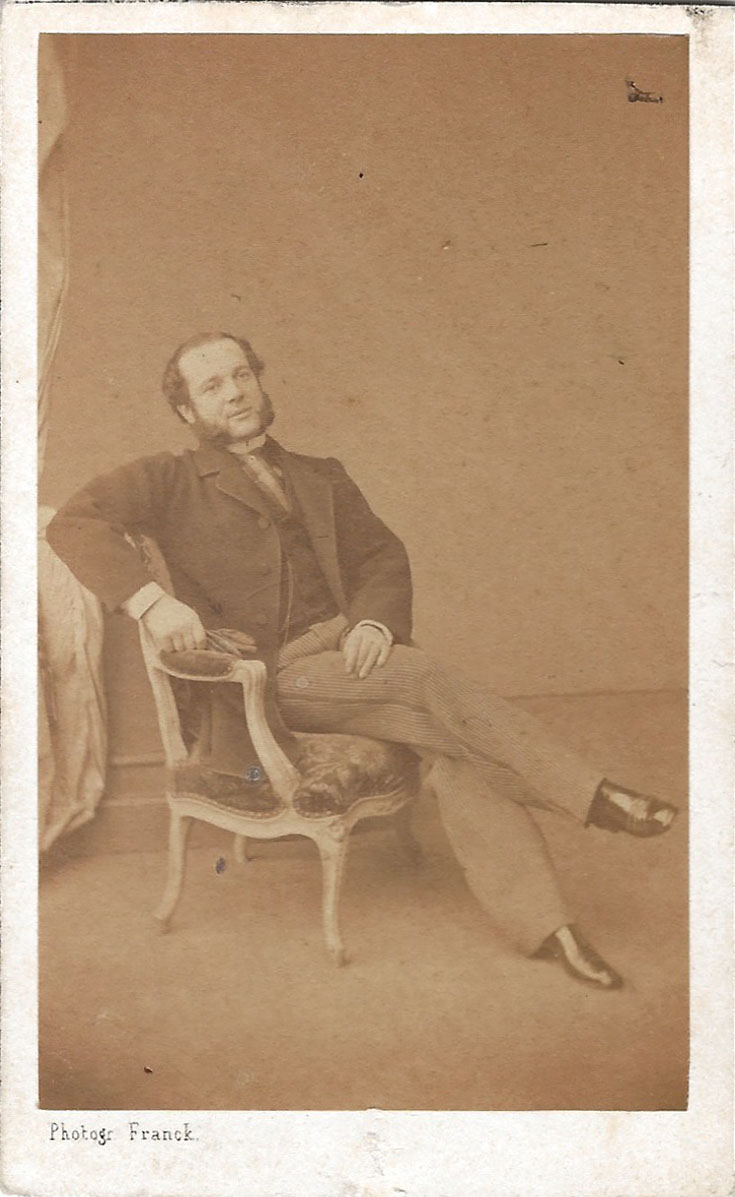
Fig. 2. Edmond Bonnaffé's Carte de Visite (by Frank).
WANTED: Catalogue des objets de haute curiosité et [...] de M. Edmond Bonnaffé (1904)
- BONNAFFÉ, Edmond (1867), Les Collectionneurs de l'Ancienne Rome, Notes d'un Amateur. Paris: Auguste Aubry, 128 pp. [in coll.: Bound by Dunezat. No. 454 of a limited edition of 600 copies.]
- BONNAFFÉ, Edmond (1873a), Les Collectionneurs de l'Ancienne France, Notes d'un Amateur. Paris: Auguste Aubry, 122 pp. [in coll.: xx binding. No. 22 of a limited edition of 606 copies, inscribed "A Mr le Comte de Béhague, Souvenir affectueux Bonnaffé" - Octave de Béhague (1826-1879) was a French collector considered one of the greatest bibliophiles of the 19th century.]
- BONNAFFÉ, Edmond (1873b), Le Catalogue de Brienne (1662), annoté par Edmond Bonnaffé (1873). Paris: Auguste Aubry, 41 pp. [in coll.: No. 119 of an edition of 200 copies on Hollande paper. Beautiful binding in lemon Moroccan half-skin and tips, gilded nerves and irons inside compartments and cover, gilded upper cut. Inscribed "A mon ami si joyeux, souvenir affectueux Bonnaffé".]
- BONNAFFÉ, Edmond (1874), Inventaire des meubles de Catherine de Médicis en 1589. Mobilier, tableaux, objets d'art, manuscrits. Paris: Auguste Aubry, frontispiece (portrait of Catherine de Médicis) etched by Rajón, 219 pp. [in coll.: No. 26 of 40 on paper of China, out of an edition of 250 copies. Beautiful binding signed by Lemardeley in Dutch hazelnut moroccan tips. Spine with ribs and gold decorations. Golden upper cut. Some minor foxing throughout. Inscribed "à mon ami de Goyeux (TBC), souvenir affectueux Bonnaffé".]
- BONNAFFÉ, Edmond (1878), Causeries sur l’Art et la Curiosité. Paris: A. Quantin, 257 pp., frontispiece by Jules Jacquemart [in coll.: Two copies: No. 3 of 50 copies on Holland paper: Original breudel, top spine missing. Inscribed "A Monsieur Louis Enault, Souvenir affectueux Bonnaffé". Combined to an unnumbered copy of similar binding but different paper, inscribed "A Monsieur Léopold Niepce, Souvenir de l'auteur Bonnaffé" - Louis Énault (1824-1900) was a French journalist, novelist and translator; Léopold Niepce (1813-1898) was an art historian.]
- BONNAFFÉ, Edmond (1882), Le Surintendant Foucquet. Bibliothèque Internationale de l'Art, Les Amateurs de l'Ancienne France, Librairie de l'Art, Paris and London, 58 pp. [in coll.: Contemporary binding. With the inscription "Alain de Mérimxx Paris 1882" on title page.]
- BONNAFFÉ, Edmond (1882), Sabba da Castiglione, Notes sur la Curiosité Italienne à la Renaissance. Gazette des Beaux-Arts, pp. 19-33 [in coll.: In original wrappers.]
- BONNAFFÉ, Edmond (1895), Voyages et Voyageurs de la Renaissance, Les Arts et les Moeurs d'Autrefois. Paris: Ernest Leroux, 172 pp. [in coll.: Inscribed "A mon cher confrère et ami Ch. Risseau (TBC) Bonnaffé". With manuscript letter tipped in: "C'est encore moi, mon ami, avec un petit volume "voyages et voyageurs de la Renaissance" qui je vous pris de parcourir à vos moments perdus. xx qu'il y a là xxx des historiettes qui pourraient amuser vos lecteurs, - quand l'on a xxx présentera de leur en parler. Merci toujours à l'avance. Autre histoire, celle-là lamentable- vous êtes aux premières loges pour être au courant des affaires de ..."]
- VASIC, D. (2021, 2024), The Verrue Sale Manuscript(s). Self-published, Researchers.One, revised 2024 [in coll.: Two printouts, 2021 version, inscribed by the author: ""]
The Legendary Verrue Manuscript Sale Catalogue, One of Only Twelve Known Copies, the Edmond Bonnaffé 'Aggregation' Copy
_titlepage.jpg)
_binding.jpg)
_inside.jpg)
BONNAFFÉ COPY - Catalogue des Tableaux de [...] la Comtesse de Verrue
Paris: Unpublished manuscript, c. 1770s
Description: [Verrue sale] (1737), Catalogue des Tableaux de Madame la Comtesse de Verrue dont la Vente a comencée le Mercredi 27 Mars 1737. Manuscript catalogue with prices and sales' total. Half-percaline binding with brown corners. With handwritten red-ink inscription by Pannier "J'ai acheté ce catalogue à la vente Bonnaffé (Janvier 1904) no. 293 du catalogue. payé xxx", engraved bookplate of G. Pannier no. 3, stamp of the Bibliothèque Heim on titlepage. Includes at the end the Randon de Boisset note, indicating a post 1777 writing (Vasić, 2024:7) - This very rare auction catalogue provides descriptions of about one hundred and eighty individual lots of famous paintings from the celebrated Verrue collection being sold at auction on March 27, 1737 (fifteen sessions), resumed on April 29 (nine sessions). The Getty Provenance Index lists fourteen copies of this extremely rare manuscript catalogue including two copies which present location is unknown. The transcriptions and the lot numbering vary from copy to copy. Vasić (2021) points out that the existing copies appear to be in the order of vacations and therefore cannot be based on an original catalogue distributed prior to the sale. The author devotes Section 3.10 to the present copy, which he designates as MS-Θ (Vasić, 2024:17-18). He writes: "Its copyist had simultaneous access to manuscripts from all three branches [see manuscript network above]. It was the approach that was radically different, as the copyist harvested the details of all three sources, and thus created a document richer in information than any of them [...] Perhaps MS-Θ emerged from the flurry of activity surrounding the Verrue sale manuscripts in the late 1770s [...] The basic tool of MS-Θ was aggregation: where some sources carried one category of information about a painting, and some carried another, the resulting description would carry both." This copy is believed to be the only one in private hands.
Provenance: Edmond Bonnaffé • G. Pannier (no. 3) • F. Heim • Jonathan Hill bookseller
References: Bonnaffé sale catalogue (1904:293); Lucien (2005:lot 478, Heim sale); Getty Provenance Index (Sale Catalog F-A14); Vasić (2024:MS-Θ)
Select a thumbnail to view its caption.
III. Decorative Arts Collecting: Furniture, Textiles & Decorative Objects
TEXT COMING LATER
See also, in the Gallery of Historical Collections:
• Collection de 124 Carnets de Bal du XVIIIe Siècle... from the Bernard Franck collection.
COMING LATER
COMING LATER
"Occuper le public de ma personne ! [...] Cela n'est ni dans mes goûts, ni dans mes habitudes. Tous ces objets, je les ai pour moi et non pour les autres. Le collectionneur le mieux loué est celui dont on ne parle qu'après sa mort. Je le regrette, mais je me vois obligé de refuser."
Baron Charles Davillier, quoted in Eudel, Le baron Charles Davillier, 1883
(In reference to his refusal to allow the publication of a notice on his collection during his lifetime; Eudel published it posthumously in 1883)
.jpg)
Baron Charles Davillier by Boldini, reproduced in Eudel (1883).
Baron Charles Davillier (1823-1883), born into a family of industrialists and bankers, was an eminent Parisian art collector and leading authority on the history of the decorative arts. Born an antiquary, as his friend Paul Eudel remarked, the young Charles, rather than spending his weekly allowance on sucres d'orge or chaussons de pommes, would wander the streets of Paris in search of curiosities, already picking out ancient medals from the dealers' boxes displayed along the riverbank (Eudel, 1883:8). For nearly thirty years, lacking the vocation of his forebears, he travelled throughout almost every country in Europe, particularly Spain and Italy, visiting museums and churches, exploring archives and libraries, and acquiring, piece by piece, the greater part of the objects that would form his prestigious collection. He devoted himself to some of the lesser-known branches of the decorative arts, bringing together the results of his investigations in a series of substantial monographs (Courajod, 1884:2). His first publication was devoted to Hispano-Moresque faience (Davillier, 1861), followed shortly thereafter by a study of the faience and porcelain of Moustiers and Marseille (Davillier, 1863). Among his many other works were a notice on the Sèvres porcelains of the Comtesse du Barry, based on the archives of the Royal Manufacture (Davillier, 1870), and a reprint, with a prefatory note, of a treatise on ceramic restoration techniques (Thiaucourt, 1865). His final contribution to the subject examined the origins of porcelain in Europe, once again drawing upon exceptional pieces from his own collection, notably Médicis porcelain (Davillier, 1882).
Beyond ceramics, he assembled outstanding collections of bronzes, jewels, tapestries, and numerous other works of art, ranging from ancient Greece to the eighteenth century. He also wrote extensively on these fields, notably publishing a study of the celebrated cabinet of the Duc d'Aumont (Davillier, 1870b). Baron Davillier naturally became an iconic figure in Parisian collecting circles, embodying the ideal of the connoisseur-collector. Yet his approach to collecting remained deeply private, as demonstrated by his refusal to allow the publication of a notice devoted to his collection during his lifetime. As he explained to Eudel, "the collector most deserving of praise is the one whose name is spoken only after his death." His reluctance was clearly not a rejection of public knowledge but rather of personal publicity. For him, collecting was an intellectual and aesthetic pursuit undertaken for personal satisfaction rather than social prestige or display. The irony is that Eudel had already planned to publish a notice on Davillier's collection and stated in the volume that he had made no promise to withhold it. The work appeared in 1883, coinciding with Davillier's death, and thus became, unintentionally, a posthumous tribute to the collector. Eudel's vivid description of his Hôtel particulier on rue Pigalle (Eudel, 1883) conveys the sense of wonder inspired by the extraordinary treasures the baron had patiently assembled. His residence became a weekly meeting place for friends and fellow collectors, among them Baron Jérôme Pichon, Champfleury, Paul Eudel, Edmond Bonnaffé, Frédéric Spitzer, and Baron Adolphe de Rothschild, together with many other distinguished figures. Upon his death, his collections were dispersed among France's leading institutions: his works of art were bequeathed to the Louvre (Courajod, 1885), his books and manuscripts to the Bibliothèque nationale de France, and his ceramics and glass to the Musée de Sèvres. Champfleury (1883) described the ceramic bequest, which included his celebrated collections of Moustiers and Marseille faience, Hispano-Moresque wares, 16th-century Médicis porcelain, and many other exceptionally rare and unique objects that had long inspired the admiration, and envy, of the collectors who visited his residence on rue Pigalle (e.g., Champfleury, 1883; Eudel, 1883).
- THIAUCOURT, Pierre (1865), Essai sur l’Art de Restaurer les Faïences, Porcelaines, Terres-cuites, Biscuits, Grès, Verreries, Emaux, Laques, Marbres, Albatres, Platres, etc. Avec un avant-propos par J.-C. Davillier. Auguste Aubry, Paris, 51 pp. [in coll.: Includes the original wrappers; bookplate "COLLECTION COLAS. Colligite quae superaverunt fragmenta ne pereant" ("Gather the fragments that remain, lest they perish"), blind stamp of the Gustave Gouellain Library, and Gouellain's handwritten note "(Donné par M. l'Abbé Colas.)". Partly detached from the binding. Moderate foxing throughout, heavier on a few leaves - Abbé Colas (1809-1874) was a bibliophile and collector of Rouen faïence. In the preface to this important work, Davillier remarks on the contemporary ceramic mania ("fièvre de la céramique") and the exceptionally high prices that rare pieces sometimes commanded.]
- Champfleury (1883), Le Baron Charles Davillier et ses Collections Céramiques léguées par lui au Musée de Sèvres. L'art: revue hebdomadaire illustrée, vol. 4, 61-65
- Courajod, L. (1884), Le Bon Charles Davillier et la collection léguée par lui au Musée du Louvre. Paris: E. Plon, Extrait de la Gazette des Beaux-Arts, 29 pp.
- Davillier, C. (1861), L'Histoire des faïences hispano-moresques à reflets métalliques. Paris : Victor Didron
- Davillier, C. (1863), Histoire des faïences et porcelaines de Moustiers, Marseille et autres fabriques méridionales. Paris : S. Castel
- Davillier, C. (1870b), Le Cabinet du duc d'Aumont et les Amateurs de son temps. Paris : A. Aubry
- Davillier, C. (1882), Les Origines de la porcelaine en Europe : les fabriques italiennes du XVe et XVIIe siècle, avec une étude spéciale sur les porcelaines des Médicis d'après des documents inédits. Paris : Librairie de l'art
A Bibliographical Rarity: Eudel's Notice on Baron Davillier's Collection, Including the Only Two Copies Printed on Pink Paper
_no1.jpg)
_no2.jpg)
_no22.jpg)
Le baron Charles Davillier, by Paul Eudel
Loc: Privately printed, 1883
Description: EUDEL, Paul (1883), Le baron Charles Davillier. Motteroz, Paris, 64 pp., with a portrait frontispiece of Baron
Davillier, in-text illustrations, and two plates hors texte. Privately printed in 120 copies, together with 2 additional copies on pink paper
for private circulation. Large octavo - Bibliographical notice devoted to Baron Charles Davillier as scholar, collector, and connoisseur.
Eudel provides a detailed account of Davillier's life, his Hôtel particulier, the works of art displayed throughout its rooms, and the
circumstances surrounding their acquisition (incl. a memorable auction in Spain). The same text, without the illustrations, was later reprinted in Eudel's 1885 omnibus volume
Collections et collectionneurs:
(i) AUTHOR COPY - Full percaline binding of the period, Paul Eudel's gilt armorial stamp in the center of the upper
cover, smooth spine with title label, original cover preserved. One of two copies on pink paper, here being no. 1 (out-of-series). Inscribed "Il a été tiré en
outre deux exemplaires sur papier rose, l'un pour la baronne Davillier et l'autre pour l'auteur, No. 1, P. Eudel."
(ii) BARONNE DAVILLIER COPY - In original covers (some irregular cover fading). One of two copies on pink paper,
here no. 2 (out-of-series). Inscribed "Il a été tiré en outre deux exemplaires sur papier rose, l'un pour Madame la baronne Davillier et l'autre pour
l'auteur, P Eudel, No. 2".
(iii) Modern binding, original wrappers preserved. No. 22, one of 20 copies printed on Holland paper. Presentation copy inscribed to A. Sickel,
accompanied by a highly significant autograph note on a blue card by Paul Eudel concerning the bibliographical characteristics of this rare notice:
"Mon cher Monsieur Sickel, la brochure Davillier tirée à un très petit nombre d'exemplaires n'a pas été mise dans le commerce - j'en ai donné quelques exemplaires et Mme
Davillier a distribué probablement le reste maintenant. C'est une petite rareté bibliographique aujourd'hui. Aussi suis-je heureux de
pouvoir vous offrir un exemplaire sur Hollande que j'avais gardé pour faire relier. Je sais qu'il sera dans de bonnes mains, enfin je m'en sépare
en votre faveur, sans regret, Mille compliments d'amitié, P. Eudel - Mon étude sur la Vente Hamilton vient enfin de paraitre chez Charpentier! Le
tirage est très restreint. Ce sera vite enlevé, je crois."
Provenance: (i) Paul Eudel; (ii) Baronne Davillier; (iii) A. Sickel
References: (i) Eudel sale catalogue (TBD)
Select a thumbnail to view its caption.
Precious Presentation Copy of a Rare Collection Notice by Baron Davillier, in a Fine Binding
_binding.jpg)
_inscription.jpg)
COMTESSE DE BARCK COPY - Les Porcelaines [...] de Mme du Barry...
Paris: A. Aubry, 1870
Description: DAVILLIER, Baron Charles (1870), Les Porcelaines de Sèvres de Mme du Barry d’après les mémoires de la manufacture Royale, Notes et documents inédits sur le prix des porcelaines de Sèvres au XVIIIe siècle. Paris: A. Aubry, 75 pp. Finely bound, with gilt top edge. Presentation copy, inscribed by the author on the flyleaf: "à Madame la Comtesse de Barck, Hommage respectueux, B.on Ch. Davillier" - Madame du Barry (1743-1793), the last official mistress of Louis XV, held the productions of the Sèvres porcelain manufactory in the highest esteem. She acquired various dinner services, vases, biscuit porcelain pieces, and furniture adorned with porcelain plaques of extraordinary luxury. For these acquisitions, she sometimes relied on Parisian marchands-merciers, but she did not hesitate to approach the Sèvres manufactory directly. In the first half of this book, Baron Charles Davillier places the importance and value of Sèvres porcelain within its historical context, and examines the subsequent exodus of these French treasures to England after the Revolution of 1789. In the second part, Davillier publishes the invoices issued to Madame du Barry by the Sèvres porcelain manufactory.
Provenance: Comtesse de Barck - Comtesse Pauline de Barck (1825-1896) and her husband, Comte Nils Barck, were prominent figures in the private European salons of the 1850s-1870s. Their social circles, travels, and collecting activities were chronicled by the Goncourt brothers.
Select a thumbnail to view its caption.
IV. Decorative Arts Collecting: Ceramics
TEXT COMING LATER
Edward Sylvester Morse (1838-1925) was an American malacologist who built the largest, most valuable and complete collection of Japanese pottery in the world (Baxter, 1887). It was during a trip to Japan in 1877 to search for brachiopods that Morse became deeply fascinated by the country's culture and traditional arts. It all began when he discovered the Ōmori shell-mounds near Tokyo, where remains of antique Jōmon pottery were found. His visit turned into a three-year stay when he was offered a post as the first Professor of Zoology at the Tokyo Imperial University. He devoted his leisure time to his collection which grew, in the course of his various journey in Japan, to over 4,000 pieces of pottery, ranging from ancient ware to contemporary ceramics. His collection included both folk pottery (mingei) (see below) and more refined, artistically crafted works. He saw beauty in simple, utilitarian designs, which was unusual at a time when many collectors only sought fine porcelain. From a second visit to the country in 1882, Morse brought back to Boston a collection amassed by government minister and amateur art collector Ōkuma Shigenobu, who donated it to him in recognition of his services to Japan. Morse became Keeper of Pottery at the Museum of Fine Arts of Boston in 1890. From 1880 to 1914, he was also a director of the Peabody Academy of Science in Salem, Massachusetts. The collection was housed in his Salem house (Baxter, 1887) before coming in possession of the Museum of Fine Arts in 1892 (sold by Morse for $76,000). By 1901, the collection had greatly expanded by gifts and purchases to 6,000 specimens. The catalogue of the Morse collection, which became one of the first and most comprehensive introductions of Japanese ceramic art to Western audiences, was published in 1901 (Morse, 1901). The Morse Collection was donated to the Museum of Fine Arts in Boston while his collection of daily artifacts of the Japanese people is kept at the Peabody Essex Museum in Salem. The remainder of the collection was inherited by his granddaughter, Catharine Robb Whyte via her mother Edith Morse Robb and is housed at the Whyte Museum, Banff, Canada. A few pottery from the Morse collection made it to the private market, for example when Morse sold some to Maria Longworth Nichols of famed Rookwood Pottery (see below).
.jpg)
The Morse Collection of Japanese Pottery by Sylvester Baxter. This very scarce 1887 article provides a brief introduction to the city of Salem's historical links to the Eastern Indies before presenting the Morse collection as found at his house in the 1880s. This is the most detailed description of Morse's collecting process while in Japan and in Salem. The four published photographs, by showing three sides of the main room and the basement room of the Morse collection, provide a unique and comprehensive view of the collection prior to his move to Boston. Baxter writes: "On the east side is an attractive brick fire-place; the shelves run entirely around the room, with the exception of this space and that of the adjacent entrance, the one window in the opposite wall, and the large window on the north, beneath which Professor Morse has his writing table [...] ." We learn from this notice how the Morse collection dwarfs all the other ones, with nearly 4,000 specimens of faïence as of 1887, over 700 different marks representing 35 provinces and 400 kinds of pottery representing 54 provinces. In contrast, the reputed South Kensington collection counts only 167 specimens (48 marks representing 15 provinces, 65 kinds of pottery representing 24 provinces) and the Captain Brinkley collection 296 (61 marks representing 12 provinces, 81 kinds of pottery representing 22 provinces).
- Baxter, S. (1887), The Morse Collection of Japanese Pottery. American Architect, May 28, 1887, 16 pp., in-text images, 4 heliotype photographic plates [in coll.: Reprint from the journal kept in contemporary cardboard folder. With bookplate "Boston Society of Natural History. S.H. Scudder Library. Gift of Samuel Hubbard Scudder, President of the Society 1880-1887, June 22, 1903" and signed "Sam H. Scudder". Hard stamped "Boston Society of Natural History" on title page and photographic plates. Stamped "Hancock Library Duplicate" on title page. The Library of the Boston Society of Natural History was claimed to be the sixth largest of its kind in the country in the first years of the 20th century. However, in 1946, it was sold to the Allan Hancock Foundation.]
A Unique Mingei Piece From the Morse Collection Representative of Cincinnnati's Japanese Mania
_1.jpg)
_2.jpg)
_3.jpg)
Slip-decorated cup
Japanese ceramics
Description: Japanese cup of simple design, of the Mingei style, once part of the Morse collection. Unsigned.
Affixed stickers and red painted numbers. These numbers have yet to be associated to any of the collections where it once sojourned (see Provenance).
While most of the Morse collection is now shared between the Boston Museum of Fine Arts and other museums, several hundred pieces were
directly purchased from Morse by Maria Longworth Nichols, an avid collector and the founder of Rookwood Pottery Factory, Cincinnati, Ohio.
As told by Trapp (1987), the transaction between Morse and Nichols happened in 1886, the year "the Japanese mania in Cincinnati climaxed." The
Japanese mania in North America started at the Centennial Exhibition of 1876 in Philadelphia after which "the American public quickly developed a
near-manic taste for things Japanese [...] In few American cities was the Japanese mania more avid than in Cincinnati [...] With the founding
of the Rookwood pottery in 1880, the powerful influence of Japanese art upon Cincinnati's decorators was soon to
become a matter of nationwide note and emulation."
Dimensions: x cm height, x cm (max.) diameter.
Provenance: Edward S. Morse (?-1886) • M. Longworth Nichols (1886-1888) • Cincinnati Art Museum (loan, 1888-1976) • Marquis J.P. de Chambrun (1976-1999). Maria Longworth Nichols (1849-1932) purchased it from Morse in 1886 and later loaned it to the Cincinnati Art Museum. It sojourned there from 1888 until 1976, when it was returned to Nichols' grandson the Marquis Jean Pierre de Chambrun. The cup finally reached the antiques market in 1999.
Select a thumbnail to view its caption.
Among the Best Association Copies of the Monumental Catalogue of the Morse Collection
_binding.jpg)
_inscription.jpg)
.jpg)
ASSOCIATION COPIES - Catalogue of the Morse Collection...
Boston: 1901
Description: MORSE, Edward S. (1901), Catalogue of the Morse Collection of Japanese Pottery. Museum of Fine Arts, Boston, Cambridge,
384 pp., 68 photogravure plates, 40 guide plates and numerous in-text potters' marks. Includes the 1912 Errata leaflet.
(i) Presentation copy for Morse's secretary Margarette W. Brooks in protective clamshell box, with a Morse collection
label put on front end-paper and lengthy inscription. Ex-library copy, stamp on the verso of title-page, uncut. Title, author
and "Inscribed by author to Margarette W. Brooks" in gilt on spine of protective box. The inscription reads: "Without
your patient assistance Margarette this Catalogue would not have been out for many years. You have been identified
with the book in every way. You helped unpack the collection, you helped arrange it. You have lived (?) all the mess,
you have worked incessantly on the proof and you have made all the indices so here it is. With the grateful appreciation
of Edw. S. Morse, Salem, Mar 26, 1901". The label consists of Morse's original sketch on paper for "Kasaizanware
(?) Musashi, Tokyo, Dated 1780, Cat. No. 4015", with pencil note "not found in Salem" and ink note "The handwriting is that of Margarette Brooks,
his secretary. Original sketch by Morse - one of the 5,000 odd cards in his own
catalog of his collection 1882-1890". It is possible that this label was kept in the present copy because the matching
object could not be found. Morse acknowledges his secretary's contribution in the catalogue preface as follows: "In
the various acknowledgments I must not omit the name of Miss Margarette W. Brooks, who has been identified with
the catalogue since the work began, and who has with infinite care copied all the manuscripts, verified the marks, and
aided in the instalment of the collection in the cases."
(ii) Paper covered boards hardcover. Inscribed by the author: "Dear Mr Macomber, I know you will appreciate the
contents of this catalogue as well as the time and labor which has been [xxx] upon it. With many thanks for your [xxx]
in the work I [xxx] Yours faithfully, Edw. S. Morse, mar. 18th 1901"; additional penned note by a later book owner:
"[xx]ne de U. Echebarria New York, dec. 10, 1936".
Provenance: (i) Margarette W. Brooks (Morse's secretary) • Boston College Library; (ii) Frank Gair Macomber • x. de U. Echebarria. Frank Gair Macomber (1877-1924) built an unparalleled collection of early Chinese pottery which he loaned to the Boston Museum of Fine Arts in 1909 (Kershaw, 1909). He also collected arms, armours, tapestries, paintings and other objects of art.
Select a thumbnail to view its caption.
COMING LATER
COMING LATER
V. Ethnographic Art Collecting
TEXT COMING LATER
COMING LATER
VI. Reflections on Art Collecting
TEXT COMING LATER
COMING LATER
COMING LATER