Milestones in the history of collecting ~ A meta-collection
The main mission of the privately funded Tricottet Collection (TC), established in 2006, is the preservation and study of historic collections and collectibles.
The TC is, in essence, a collection of collections, or a meta-collection. It brings together pedigreed objects from notable private collections, rare collectibles, and materials relating to the history of collecting (Collectiana): collection catalogues and notices, portraits of collectors and their cabinets, as well as ephemera such as correspondence and related documents. Its purpose is to assemble and curate a representative body of material that illustrates the history of collecting [read more].
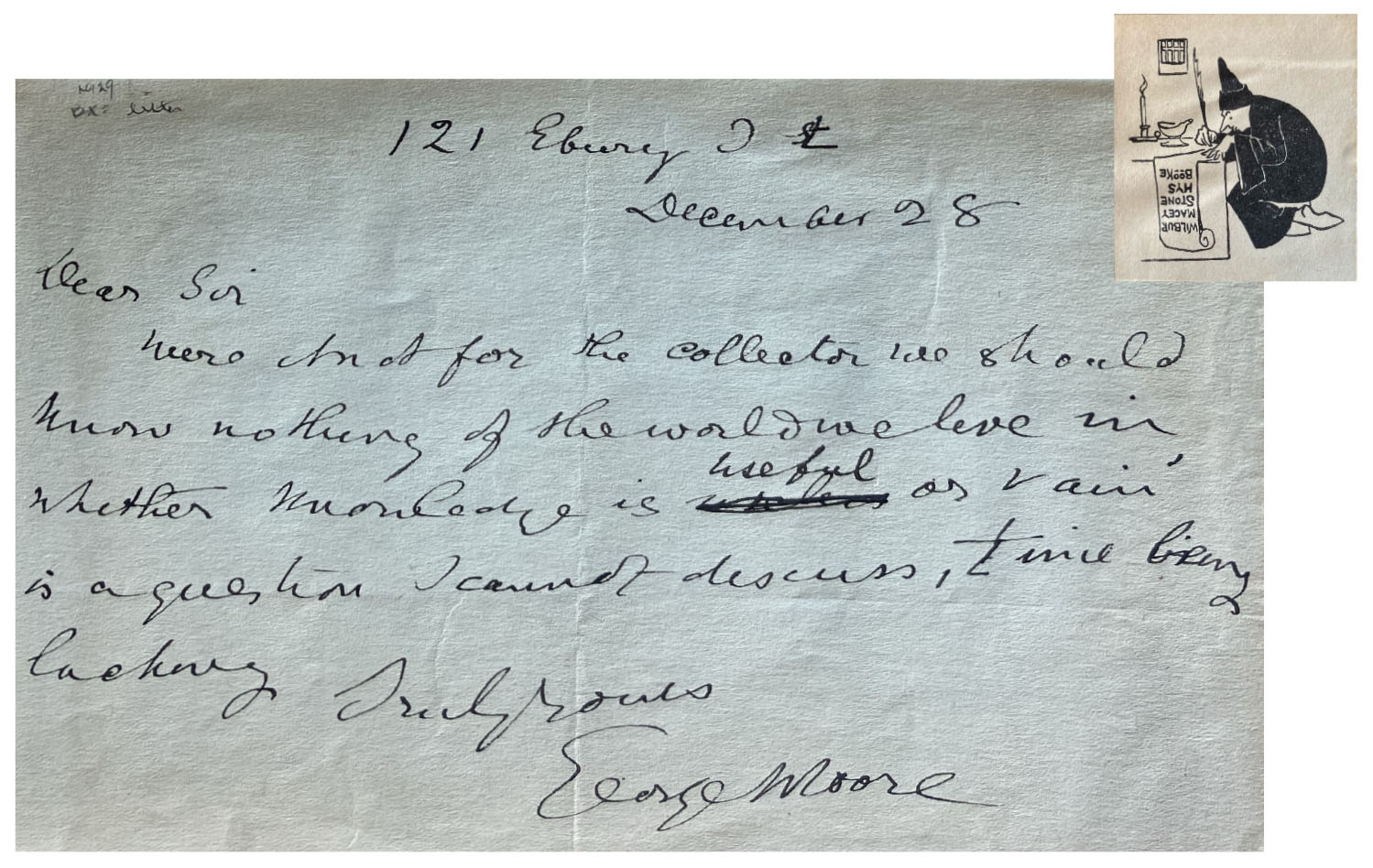
"Dear Sir, were it not for the collector we should know nothing of the world we live in. Whether knowledge is useful or vain is a question I cannot discuss, time being lacking. Truly Yours, George Moore" - From one of the most celebrated Irish novelists of his generation to distinguished collector Wilbur Macey Stone (tipped into his copy of Vale, 1914)In these few lines, Moore produced what may fairly be called an unpublished micro-treatise on collecting, affirming the indispensable role of the collector in preserving our knowledge of the world — Part of the Tricottet Collection.
Collection Categories
The history of collecting is explored through eight categories, listed alphabetically: art collections, book collections, geological collections, historical collections, instrument collections, natural history collections, pop culture collections, and Wunderkammern. Each category has its own Gallery, showcasing a curated selection of objects from the TC that illustrate distinctive aspects of collecting within that field. Within each category, the objects are organized by subcategory and then presented in chronological order, offering a journey through the evolution of collecting across different themes and periods. Collection catalogues constitute an integral part of every category. They document many of the objects preserved in the TC and, in cases where the original collection or its objects have not survived, or where their provenance has been lost, they often provide the only remaining evidence of their existence.
Art Collections
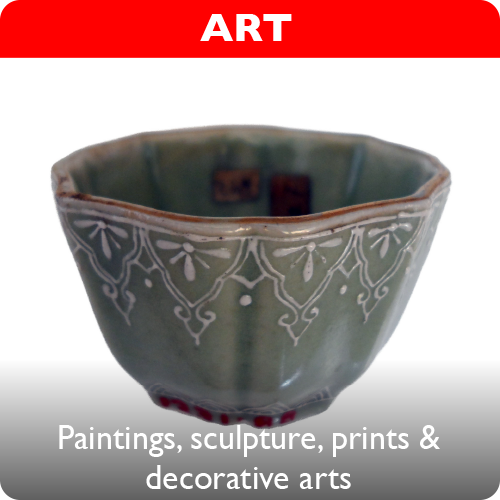
This gallery primarily features rare collection catalogues and sale catalogues from renowned art collections, many of which have been cherished by multiple generations of collectors. A highlight is a copy of the legendary manuscript sales catalogue of the Comtesse de Verrue collection, once owned by collection historian Edmond Bonnaffé. Other notable items include 18th-century art sale catalogues from the Edmond de Goncourt collection and a set of rare ceramic collection catalogues from the library of collector Gustave Gouellain. One particularly remarkable object is a Japanese ceramic cup that retains its full provenance since being collected by the renowned collector Edward S. Morse during the Cincinnati Japanese Mania. The Gallery also includes the only dedication copy of a collection catalogue held within the TC.
Book & Manuscript Collections
The history of book collecting has continually reinvented itself. While early bibliophiles pursued manuscripts, incunabula, and fine bindings, twentieth-century collectors increasingly assembled libraries devoted to individual authors, specialized subjects, and popular culture. The present gallery traces these evolving forms of bibliophily through rare books and collection catalogues drawn from some of the most important collections of their time, spanning from the Renaissance to the turn of the twenty-first century. The bibliophile's passion is reflected in carefully selected volumes valued for their rarity, condition, provenance, or fine bindings. Many of the works presented here bear collectors' bookplates or annotations noting their significance within a private library, and their chains of ownership can often be reconstructed through collection and auction catalogues. Collection catalogues, together with related documents on the history of collecting, are presented throughout the Tricottet Collection beyond this gallery when relevant to other fields.
Geological Collections
Mineral collecting is among the oldest forms of scientific and aesthetic collecting in the Western world, with origins that can be traced to the Renaissance. During the Enlightenment, it flourished throughout Europe. Aristocrats, wealthy landowners, mine proprietors, and scholars assembled collections motivated by a combination of scientific curiosity, social prestige, and an appreciation for beauty. Surviving mineral specimens with documented provenance from the 18th century are rare and particularly cherished by the TC. With collecting becoming more widespread in the 19th century, the pedigreed specimens presented in this gallery were carefully selected from some of the most celebrated collections of their time, from Great Britain to the United States, via Central Europe. By the late 19th century, a new generation of collectors emerged, devoted to meteorites, culminating in the establishment of the first dedicated meteorite museum by the mid-20th century. Tektites, enigmatic black stones once thought to have originated on the Moon, were collected across Africa and Asia. Meanwhile, mineral collectors increasingly developed an appreciation for provenance and collecting history.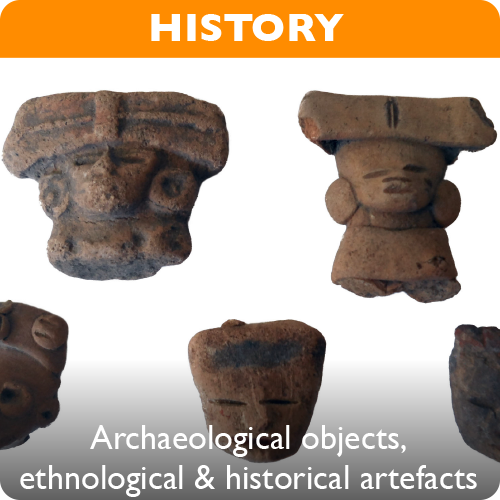
Historical Collections
The collecting of historical artefacts has become increasingly specialised over time. During the Renaissance, the collection of the relics of classical civilisation by the so-called Antiquarians, undertaken to complement humanist learning from ancient texts, laid the foundations of modern archaeology and related disciplines such as numismatics and epigraphy. As exploration and travel broadened European horizons, collecting interests expanded beyond Greek and Roman antiquity to encompass the civilisations of ancient Egypt, the Americas, and other cultures. History and society are inseparable, and ethnological collections therefore form an integral part of the present gallery. From the 19th century onward, collecting became ever more specialised as new historical events, social institutions, and cultural developments created fresh areas of interest. Philately, historical photography (documenting people, places, and events), advertising ephemera, and memorabilia associated with notable individuals are but a few examples. Whether preserving the legacy of a great historical figure or documenting the material culture of everyday life, these collections provide invaluable insights into the past and the societies that shaped it.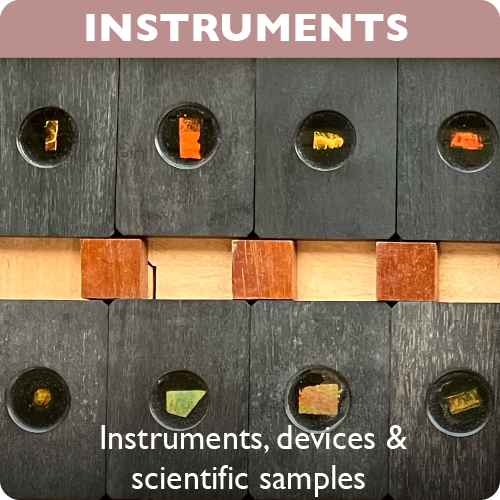
Instrument Collections
This gallery explores the history of collecting instruments and other functional objects, valued for their craftsmanship and historical importance as much as for their practical uses and technical ingenuity. The fields represented include calculation, observation, measurement, and communication. The instruments represented, whether as pedigreed objects or through rare collection catalogues, include calculating machines, microscopes, timekeepers, automata, and musical instruments. Related paraphernalia include microscope slides, anatomical preparations, and phone cards. For the unreachable collectibles that are unique and locked away in museums or carry price tags exceeding a million dollars, the so-called 'Mona Lisas', this gallery presents rare archives that reveal how these legendary objects have circulated and passed through collections over decades and even centuries. These include Stradivarius violins, the Jaquet-Droz automata, the Antikythera Mechanism, and Babbage's Difference Engine. At the other end of the spectrum, common collectibles such as microscope slides and phone cards are represented by their top-tier examples, the so-called 'Holy Grails', which may also reflect particular collecting crazes in history.
Natural History Collections
Natural history collecting emerged from the traditions of the Wunderkammer, but gradually developed into more specialized disciplines increasingly focused on naturalia. Over the centuries, collectors gathered, classified, and exchanged specimens in an effort to understand the natural world. Many scoured their local landscapes in search of shells, plants, animals, and fossils, while expanding networks of maritime trade brought an unprecedented diversity of exotic specimens to European collections. During the Enlightenment, cabinets increasingly shifted from the Renaissance fascination with antiquities toward collections devoted to natural history. The fascination for shells gave rise to conchyliomania, with exceptional specimens commanding prices comparable to works by celebrated Dutch Masters. In the 19th century, and particularly in Victorian Britain and throughout the Commonwealth, natural history collecting became a widespread pursuit, giving rise to numerous specialized enthusiasms such as pteridomania, the Victorian passion for ferns. In this Gallery, rare collection catalogues are presented alongside a variety of historically documented natural objects, including shells, fossils, taxidermy specimens, and herbaria.
Pop Culture Collections
Unlike many traditional collecting fields, whose origins often extend back centuries, pop culture collecting is predominantly a 20th-century phenomenon, emerging alongside mass consumer society, modern advertising, and the rapid expansion of entertainment industries. Many of the objects featured in this section were originally produced as ephemeral commodities rather than as items intended for preservation. Toys, video games, comic books, trading cards, sports memorabilia, and movie posters were often designed for immediate use and, in some cases, eventual disposal. Unlike many other collecting fields, where collector-generated labels and documentation often form an integral part of the object's history, popular-culture collectibles typically already carry identifying information supplied by manufacturers, publishers, or licensors. As a result, well-documented pedigreed collections are comparatively uncommon. The Tricottet Collection has nevertheless assembled a representative suite of such collections, together with several celebrated 'holy grails,' illustrating both the diversity of the field and the ways in which everyday consumer products can acquire lasting historical significance.
Wunderkammern
The Wunderkammer, or cabinet of curiosities, emerged in the Renaissance as a microcosm of the known world, gathering naturalia and artificialia into a single densely arranged space. Illustrated catalogues of these early collections, predecessors of the modern museum, have become iconic. By the Enlightenment, the appetite for wonder gave way to a more systematic, scientific ordering of objects, exemplified by encyclopaedic collections still encompassing all domains of collecting. Such a prouesse was the achievement of a few individuals both wealthy and dedicated enough to pursue it, but the growing number of collectibles soon made specialisation an ineluctable outcome. Yet interest in collecting topics pêle-mêle persisted, producing chroniclers who registered the cabinets known to exist, and critics who railed against the enduring "mania" for curiosities. The 19th century split the fate of the Wunderkammer in two. Erudite scholars explored the very act of collecting, crafting an idealised vision of curiosities. Elsewhere, curiosities were repackaged for mass entertainment in the dime museum. Serious interest in the original Wunderkammer only resurfaced at the close of the 20th century.Publications ~ Research on the collecting process
MIGNAN, Arnaud, WILSON, Wendell E. (2026), Count Jacques-Louis de Bournon (1751–1825) and his Mineral Collection. The Mineralogical Record, 57(3), 325-345.
MIGNAN, Arnaud (2021), William Elias Helman Pidsley (1867-1905) and his collection of birds. Archives of Natural History, 48(2), 396-399.
MIGNAN, Arnaud (2018), Metacollecting or the process of collecting collections, with examples from The Tricottet Collection. Colligo, 1(2), 35-50.
MIGNAN, Arnaud (2016), Metacollecting and use of "collection-objects" in prosopographical studies of meteorite collections. Meteorites, 4(1-2), 11-22.
MIGNAN, Arnaud, REED, Blaine (2012), The Monnig Meteorite Collection Numbers Revisited. Meteorite magazine, 18(3), 10-13.